

Virtual Intelligence and the Pink Slip
The ELIZA error in the C-Suite: substitution bets, AI-costumed layoffs, and the largest pay-to-participate beta test of all time


I.
On April 28, 2025, Duolingo posted a memo on its LinkedIn page from co-founder and CEO Luis von Ahn. “Duolingo is going to be AI-first,” von Ahn wrote. He compared the decision to the company’s 2012 bet on mobile, the one that had made Duolingo the most downloaded education app in the world. “We’re making a similar call now, and this time the platform shift is AI.” The memo announced what it called “a few constructive constraints.” Duolingo would “gradually stop using contractors to do work that AI can handle.” AI use would become part of hiring decisions and part of performance reviews, and “headcount will only be given if a team cannot automate more of their work.” [1]
The memo’s most revealing sentence was about timing. “We can’t wait until the technology is 100% perfect,” von Ahn wrote. The company would “move with urgency and take occasional small hits on quality.” [1]
Two days later, Duolingo announced the largest content expansion in its history: 148 new language courses (more than doubling its catalog) built with generative AI. “Developing our first 100 courses took about 12 years,” von Ahn said in the press release, “and now, in about a year, we’re able to create and launch nearly 150 new courses.” [2]
Read together, the memo and the announcement seem contradictory. The memo asserts that headcount can be reduced by automating work, but the work being automated was being done by human beings with the skills necessary to build the courses. What is not addressed is where the quality of Duolingo’s pre-AI content came from and what mechanisms will ensure the same level of quality will hold with generated content.
II.
“ – work that AI can handle.”
Handle is doing work that is not immediately obvious. It’s not a precise or measured term; something can be handled successfully but still in a fashion where the quality is not all that could have been achieved.
The Duolingo memo is one example of a pattern visible across the corporate world. C-suite executives are making replacement decisions on the assumption that the systems they are deploying know and understand the work — but generative systems do neither in the way humans mean when they say those words about other humans. These systems have no interest in the quality of their output. The usual human motivators — material reward, job satisfaction, the fear of a bad review — do not apply, and neither do the usual correctives. What remains, after positions are closed and workers are let go, is the question of whether the demonstrated capability of generative systems justifies restructuring enterprises and their workforces around them.
Before asking whether AI’s demonstrated capability justifies restructuring a business around it, it is necessary to ask where the capability being demonstrated is coming from — whether it resides in the system itself or in the exchange between the system and the skilled people operating it. AI-first memos do not ask the question at all; or if it was asked, what the answer was. The use of the word “handle” is not encouraging.
I examined, in “Virtual Intelligence and the Workplace”, what happens to the workers who remain when AI adoption becomes a condition of employment. [3] This essay is about the workers who do not get to remain: the ones who are laid off before any exchange with the new system takes place, and the consequences of treating human intelligence as a line item.
What is consistent across the cases we will examine, and what makes them worth examining as a class rather than as individual corporate decisions, is the sequence that unfolds in much the same way each time. AI’s capability is asserted. The workforce is reduced. The demonstration that the capability holds without the workforce is not scheduled, or is scheduled to arrive at some future time, or (as von Ahn’s memo put it) is acknowledged as incomplete, with the shortfall accepted in advance as the cost of moving quickly. The assertion is available to do the work of satisfying shareholders, whether or not it describes a completed fact. The evidence of AI business benefit will follow the layoffs, if it follows at all.
III.
For “work that AI can handle” to be a safe bet in the business world, something must be true about where the quality of the work was coming from, which is: it’s a product of data-driven inputs, not of the things people do with them. If that’s the case, then the workers were a cost that can be removed without consequence. If it was coming from the exchange between skilled people and the systems they were working with, then removing the people does not remove a cost. It removes the thing that was making the work good to begin with.
What a skilled course contributor supplies is judgment. This includes pedagogical judgment which, in the case of Duolingo, includes knowing where learners of a particular language stumble; which cultural framings make an example land or fall flat; and when a technically correct translation teaches the wrong lesson. An English speaker encountering the Spanish word embarazada — a false cognate that looks like “embarrassed” but means “pregnant” — needs a lesson built by someone who knows which wrong guess is coming, knows that every English speaker makes it, and has decided exactly when in the course to set the trap and spring it kindly. That kind of expertise has not been demonstrated in machine learning or generative systems deployed at this scale. For humans, it accumulates over years of watching real learners fail in instructive ways, and it is exercised in the exchange between the contributor, the material being taught, and the student who wants to learn.
I’ve made this one claim more often than any other in this series: the intelligence that users encounter in generative systems arises in the exchange between the user and the system, not inside the system itself. Replacement of workers under these circumstances is what happens when an executive gets that location of the intelligence wrong with real money on the table.
The error is easy to misstate, and the misstatement is how it gets dismissed. The error is not a belief in machine consciousness; It’s likely no CFO believes that the company’s language model has a mind. The error is a misjudgment about where competence is located. In 1966, Joseph Weizenbaum wrote the program ELIZA — a few hundred lines of script that simulated a Rogerian therapist — and watched people attribute understanding to it. The “understanding” they experienced was their own, projected onto fluent output from a machine that, as Rogerian therapists do, repeated back what they typed. [4] The executive reviewing a fluent-seeming AI-generated course module or customer-service transcript is making the same projection: the fluency is read as competence, the competence is assumed to be in the system somewhere, and the people in whom it actually lives become a cost that can be cut.
The people closest to the work can feel where the exchange helps, because they are the ones doing the work. The executive sees only output, and output is the one thing fluent systems are best at making look finished. The resemblance between fluent output and finished work has already led professionals across widely different fields to public embarrassment. Distance from the work rises along the org chart, and the people making decisions about the tools are also deciding how much loss of quality is acceptable if the use of AI can justify a reduction in headcount.
Von Ahn’s memo, recall, accepted “occasional small hits on quality” in advance. A reader sympathetic to the decision might see this as evidence against the error I am describing — a leader who acknowledges quality loss is not confusing the machine for the worker. The objection gets it backward. Calling the hits “small” and “occasional” is the error at work: it is a judgment about how much quality will be lost, and that judgment is only available to someone who has already decided, from the top of the org chart, that the quality contributed by the people being removed was modest enough to absorb. An executive who understood that twelve years of pedagogical judgment lived in the exchange — not in the strings the system was trained on — would not describe its removal as a small hit. Calling the loss “small” and “occasional” is not an observable fact — it is a forecast, and one made from a position that lacks access to the granular, case-by-case knowledge of which lessons required human judgment to avoid subtle pedagogical or cultural errors. From the top of the org chart, that accumulated judgment is invisible; what is visible is the cost line.
These tools did real work for Duolingo; it’s 148 courses better off than it was before. The compression of twelve years of course development into roughly one year is a real fact, and the company’s financial statements show per-unit AI costs falling while margins expand. [5] The question von Ahn’s original memo never asks is what made a Duolingo course worth taking — what expertise accumulated over those twelve years, and whether that expertise survived the compression. The contributors closest to that answer — the contractors whose judgment had accumulated over those years — were the first to be let go.
CEFR — the Common European Framework of Reference for Languages, a six-level proficiency scale running from A1 (beginner) to C2 (mastery) — is a level-appropriateness rubric. It measures whether content is pitched correctly for a B1 or C2 learner. The distinction between level compliance and lesson design is visible in Duolingo’s own account of the surviving quality process. A company spokesperson told TechCrunch in January 2024 that GPT was used to translate sentences and then “human experts validate that the output quality is high enough for teaching and is in accordance with CEFR standards for what learners should be able to do at each CEFR level.” [20] Designing to CEFR level does not measure whether a lesson is well-designed: whether the embarazada trap is set at the right moment in the curriculum, whether a cultural framing misleads, or whether a technically correct sentence teaches the wrong instinct. The surviving validation, by the company’s own description, checks level compliance. The removed expertise did lesson design. These are not the same skill, and measuring one does not confirm the presence of the other.

IV.
Not every layoff narrated by the C-Suite as an AI transformation is a bet that substituting AI for human headcount will pay off. A critic of these layoffs who pretends otherwise hands the other side its easiest rebuttal. Three recognizable components appear in these decisions, separately or in combination:
The first category is the genuine bet, and the category this essay is concerned with: a leadership team that believes the system can do the work and removes the workers on that belief. The most instructive case is Klarna. In December 2023, the Swedish fintech firm froze hiring. In February 2024 it announced that its OpenAI-powered customer service assistant was doing “the equivalent work of 700 full-time agents,” handling 2.3 million conversations in its first month across 35 languages. [6] Just fifteen months later, in May 2025, CEO Sebastian Siemiatkowski told Bloomberg the company was hiring human agents again. “What you end up having is lower quality,” he said. [7] The bet did not pan out in Klarna’s case, where it swiftly discovered just what it had discarded.
The second category is ordinary cost-cutting in an AI costume. “Pivoting to AI” is a better press release than some of the alternatives, and some of the alternatives are very bad. When Meta announced in April 2026 that it would cut 10 percent of its workforce while redirecting investment toward AI, the announcement arrived against the backdrop of the company’s Reality Labs division having accumulated more than eighty billion dollars in operating losses since late 2020. [8] “We are restructuring for AI” and “our last platform bet lost eighty billion dollars and we need to find the money for an AI pivot somewhere” look the same on a balance sheet and the former sounds much better as a press release. The research company Forrester gave this practice a name in January 2026: “AI washing,” the attribution of financially driven workforce reductions to AI implementations that do not yet exist. [9]
The third is the simplest: headcount was too high for the business to operate most profitably even without AI. The technology sector hired enormously during the zero-interest-rate years, and a meaningful share of AI-era workforce reductions is that excess hiring starting to unwind in the form of mass layoffs. AI supplies a forward-looking story for a backward-looking, business cycle problem. A statement about the future is more pleasant to post on the company news site than an admission about past C-Suite errors.
These categories describe what companies did, not what their leadership believed, and the executive may not know which category applies. The ELIZA effect does not only supply public cover for the executive who knows the restructuring is really about costs; it supplies private cover for the one who does not — because a headcount correction can feel, from the inside, like a technology bet, and the technology bet is the more satisfying thing to believe about one’s own decision. Nobody needs to be lying for the costume to fit, and we cannot know what executives believed when they made their decisions.
Real cases, including Duolingo’s, are composites. The contractor reductions produced measurable cost savings; the company’s growth was normalizing after its pandemic surge; and the AI implementation delivered 148 courses at compressed cost. Elements of all three categories are present in the same decision. Duolingo does not sort neatly into a single bin. The capability claim (“work that AI can handle”) is what is interesting, it is inherently a judgment about where competence lives. The other components indicating other categories are real, and they may be sufficient on their own to explain the decision in some cases. They do not explain the claim, and the claim is what this essay is about.
This separation into categories is important because the outcomes are different. Klarna’s bet was lost because customer-service quality is visible from the outside — customers experienced the degradation and said so, in volume, where the company could not avoid hearing them. Most institutional knowledge is not like that, and knowledge imparted carelessly or badly can be as damaging in its own way as ignorance. Imperfect understanding of a subject transfers to learners, who may plateau in their studies prematurely without understanding why, or find themselves unable to cope with real world situations they could have been prepared for.
V.
Every AI-attributed workforce reduction carries a second action that has nothing to do with whether the substitution works. The announcement itself — the memo, the press release, the CEO’s LinkedIn post — is a public assertion that prices the work that humans do down on the day it is published, before any evidence that substitution with AI pays off exists. The assertion is typically authored or at least issued at the highest level of the company. The disproof, if it ever comes, will probably be slow to come and quietly announced, if at all. A worker whose role has been publicly declared redundant is not restored to value by a quality problem discovered six months later in an internal audit that nobody can see outside of the company. The harm is caused in the wide gap between the assertion of capability and the proof of it — and in every case where the proof of capability never arrives, the public devaluation of human effort in the workplace was levied for no gain at all.
An objection presents itself: every corporate restructuring announcement devalues something. Announcing a factory closure reprices the work of the people who ran it. The distinction is that a factory closure communicates a decision that has been made; the decision is the fact, and the announcement reports it. An AI-attributed workforce reduction communicates something different: a capability claim. “AI can handle this work” is an assertion about the system’s competence, and the assertion is doing the work of a demonstration that has not occurred. The harm is not in communicating a business decision. It is in publicly asserting, as accomplished fact, a capability that has not been demonstrated — and imposing the labor-market consequences of the assertion on workers, before any evidence supports it. When the capability is later shown to hold, the announcement was accurate and the repricing was legitimate. When it is not, the workers were devalued for nothing, and the nothing was asserted with the authority of a CEO’s signature.
This series has seen the underlying structure before. In “Virtual Intelligence and the Harms Race”, I described how AI firms convert danger into capability marketing: the claim that a product is so capable it threatens how civilization functions, structurally, as a boast. [10] “Our systems are so capable we no longer need these workers” is the same structure applied to the world of labor and corporate expenditure. Both convert a liability — risk in one case, human cost in the other — into a capability advertisement aimed at investors. The layoff announcement signals that the company is lean and ahead of the technology curve, and that signal has value to shareholders independent of whether the substitution it describes actually works.
A signal, though, can be aimed at one audience and overheard by others. No company illustrates that problem more completely than the one this essay began with: Duolingo.
Users who had spent years inside Duolingo’s deliberately unhinged brand personality — the menacing owl, the viral TikTok skits, the Super Bowl stunts — read “AI-first” as a betrayal of the thing they had been paying for, and they said so. Longtime users posted themselves deleting the app, breaking usage streaks of a thousand days and more. On May 17, the company wiped every post from its TikTok account — 6.7 million followers — and from its Instagram account, 4.1 million more, after both were flooded with hostile comments. The company had lost more than 400,000 TikTok followers in roughly three weeks. [11] On May 20, Duolingo returned with a cryptic video of a three-eyed owl. It read less like a marketing campaign than an impromptu act with a hint of desperation about it. [12]
Around May 22, von Ahn posted again. “One of the most important things leaders can do is provide clarity,” he wrote. “When I released my AI memo a few weeks ago, I didn’t do that well.” [13] The clarification reassured full-time employees. It retracted nothing about contractors.
The enacted reductions targeted contract translators and content creators. The original announcement — “AI-first,” headcount conditioned on automation failure — was heard by every employee, every user, and every observer as a statement about how human work was valued at the company in general. The memo marked the value of that work down on the day it was published. For a consumer brand whose entire public identity was built on perceived humanity and a deliberately human sense of humor, the capability advertisement aimed at investors was a liability the moment the rest of Duolingo’s audience heard it.
The obvious objection is that the bet worked. Duolingo did not collapse. Daily active users grew between 40 and 49 percent year over year through mid-2025. The company crossed 50 million daily active users that November. Margins expanded as per-unit AI costs fell. [14] If the measure of the AI implementation is the income statement, the implementation won. The costs it incurred are not listed there.
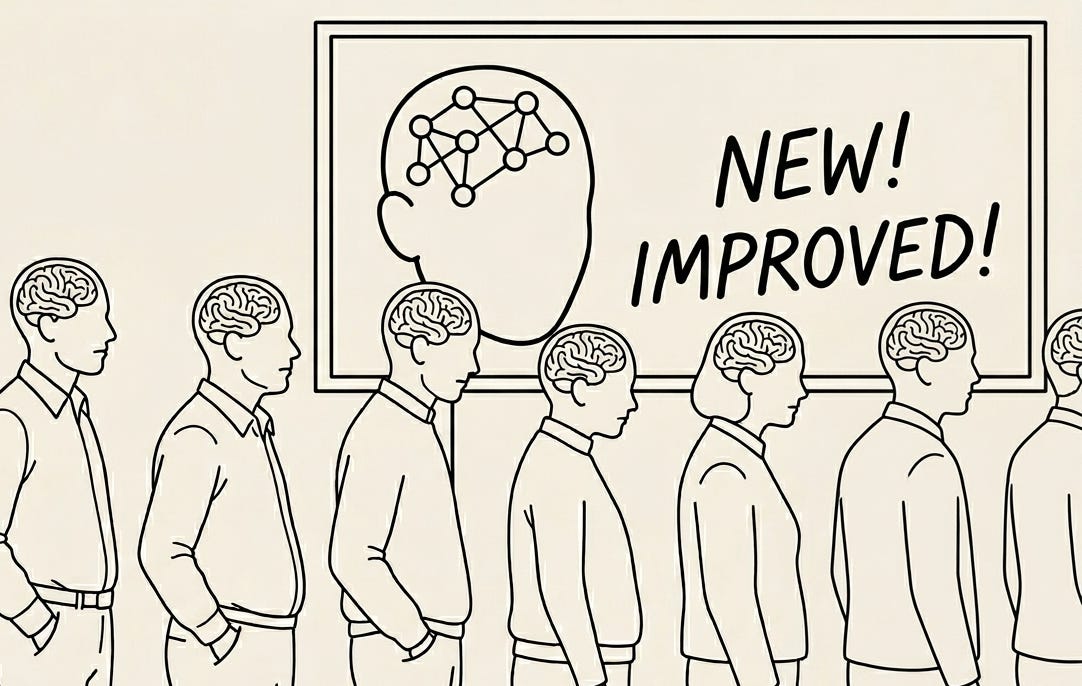
Duolingo’s shareholder letters identify some of those costs. The Q3 2025 letter conceded that user growth had slowed “in part because we posted less ‘unhinged’ content on our English-speaking social media accounts as we listened to community feedback” [15]. In a document filed with the SEC, the company acknowledged that the brand voice the backlash forced it to silence had been a growth engine. By February 2026, Duolingo was guiding its 2026 user growth to approximately 20 percent, after three years in which the number had not fallen below 40. [16] The company attributed the slowdown to scale and to monetization friction, and those explanations are plausible. The threads cannot be fully separated from outside. The thread the company itself conceded is enough: the signal had a price, and some of it was paid in the brand trust the announcement damaged.
VI.
Almost nobody at Duolingo had to be laid off. In January 2024, the company reduced its contractor base by roughly 10 percent as AI took over translation work. The statement to Bloomberg read: “We just no longer need as many people to do the type of work some of these contractors were doing. Part of that could be attributed to AI.” [17] The contractors were not laid off, in the company’s account: they were at the end of contracts that were not renewed. The spokesperson’s word for it was “offboarded.” Firsthand accounts reported by TechCrunch are consistent with this description. A former contractor, writing on Reddit under the handle No_Comb_4582, described the experience from the inside: “They kept a couple people on each team and call them content curators. They simply check the AI crap that gets produced and then push it through.” The post included a screenshot of the exit survey email, dated December 15, 2023, requesting that departing contractors complete a two-minute survey and collect their Certificate of Earnings. [20] A second former contractor, posting on X, noted that “a majority of their workforce are contractors (ie no benefits or job security).” [20]
In August 2025, after the memo and the backlash, von Ahn told The New York Times: “We’ve never laid off any full-time employees. We don’t plan to.” [18] This is true if misleading.
Contractors are not employees, so removing them is not a layoff. A non-renewal is not a termination, so nobody is fired. An offboarding generates no severance, no legal notice requirement, and no headcount reduction event that anyone is obliged to report as part of the regular collection of statistics. The AI substitution bet was tested on the segment of the workforce that is easiest to remove because it is the least counted: the people with the thinnest protections, the least standing to contest the decision, and no presence in the statistics by which workforce reductions become visible. The accountability chain this series proposed in an earlier essay runs from designer to deployer to user; here, the deployer has arranged the situation so that the link bearing the cost is the one the org chart barely records – if at all. [19]
No pink slips were issued. That is the point.
VII.
Duolingo is one company. In a pattern visible across the technology sector and increasingly beyond it, firms have spent the past two years removing workers on the basis of AI capability claims that have not been demonstrated, paying for the privilege in enterprise subscriptions, restructuring costs, and reduced or destroyed institutional knowledge, while the workers pay with their livelihoods. The thing being tested is whether the substitution works at all. This is the largest pay-to-participate beta test of all time.
The argument here is not that AI does no useful work. Duolingo’s tools did useful work — the 148 courses exist, and the cost curves bent. The argument is that the sequence runs on faith about where competence lives. A company that demonstrates the substitution first and removes workers second is adopting a technology. A company that removes workers first is enrolling them, without their consent, as the control group in an experiment on themselves.
A beta test is supposed to return a verdict. This one does not return a verdict on the question that matters — it returns a verdict on the question the company chose to ask. The institutional knowledge destroyed by the workforce reduction was not the company’s only source of measurement — Duolingo retained its product teams, its analytics infrastructure, its A/B testing capability, its quarterly metrics. What it lost was the capacity to measure the specific thing the contractors had supplied: the pedagogical judgment that determined whether a lesson taught well or merely taught. DAU measures whether users open the app. Retention measures whether they come back. Neither measures whether an English speaker was taught something subtly wrong about embarazada, or whether a cultural framing that would have been caught by a skilled contributor went live uncorrected. Klarna got its verdict because customer service quality is immediately visible to the people experiencing it — the customer calls back, the complaint is filed, the failure is loud. Klarna’s reversal does not prove that AI substitution fails across domains. What it proves is that customer service is a domain where failure is immediately audible.
The lesson for other domains is not that the same failure will occur, but that when it does, it may arrive silently. Pedagogical quality is not like that. A learner who plateaus does not file a complaint; a lesson that teaches the wrong thing produces no error message. The instruments that survive measure whether the company is succeeding on its own metrics. They do not measure whether the substitution preserved the quality that made the product worth using. Duolingo’s own stated quality mechanism illustrates the gap: CEFR validation confirms that a lesson sits at the right proficiency level; it does not confirm that the lesson teaches well. A company measuring its AI-generated content against CEFR standards and finding compliance can declare the substitution a success — and be correct on the metric, and wrong on the question.
In “Virtual Intelligence and the Doom Industry” I criticized the position that superintelligent AI poses an existential risk as unfalsifiable — a claim structured so that no evidence could contradict it. [21] The substitution bet is not unfalsifiable in the same way; it does return numbers, and the numbers can look good. The problem is that it is evaluated against the metrics the company chose rather than the quality the workers supplied. A bet measured against metrics that omit the displaced quality can appear to win indefinitely.

The culpability framework this series proposed is an ethical one, not a legal theory — the terms are defined in “Virtual Intelligence and the Accountability Chain” as moral categories describing the relationship between a decision-maker’s available information and the harm produced, not as causes of action under tort or corporate law. [19] Negligence, in this framework, means failing to consult or preserve available expertise before imposing foreseeable harm on others; recklessness means proceeding after evidence of comparable failure has become available. Within those definitions, making a bet with other people’s livelihoods on an unexamined assumption about where competence lives — when the people who could have informed the assumption were on the payroll and available to be asked — meets the standard for negligence. Placing the same bet after May 2025, with Klarna’s result published and its costs quantified, meets the standard for recklessness: the information was available, and the bet was placed anyway.
Duolingo’s memo accepted “occasional small hits on quality” in advance, as the price of moving with urgency. Fourteen months later, no public accounting of those hits exists, and none is forthcoming. The people best positioned to detect those losses at the point of creation were the first to be let go.
Footnotes
[1] Luis von Ahn, all-hands email, published by Duolingo on its corporate LinkedIn page, April 28, 2025. The post’s authenticity and full text are documented by Snopes: https://www.snopes.com/fact-check/duolingo-ai-first/. Contemporaneous coverage: Jonathan Limehouse, “Duolingo going ‘AI-first’, replacing contractors with artificial intelligence: CEO,” USA TODAY, April 29, 2025, https://tech.yahoo.com/ai/articles/duolingo-going-ai-first-replacing-171120431.html.
[2] Duolingo, Inc., “Duolingo Launches 148 New Language Courses,” press release, April 30, 2025, https://investors.duolingo.com/news-releases/news-release-details/duolingo-launches-148-new-language-courses.
[3] Christopher Horrocks, “Virtual Intelligence and the Workplace,” Virtual Intelligence (Substack), April 2, 2026.
Virtual Intelligence and the Workplace

Mandatory AI at work: cognitive surrender, consent, and what employers owe the workers they deploy AI on.
[4] Joseph Weizenbaum, “ELIZA — A Computer Program for the Study of Natural Language Communication Between Man and Machine,” Communications of the ACM 9, no. 1 (1966); Joseph Weizenbaum, Computer Power and Human Reason (W. H. Freeman, 1976).
[5] Duolingo, Inc., Q1 FY2026 shareholder letter, May 4, 2026, https://www.sec.gov/Archives/edgar/data/0001562088/000162828026029790/q1fy26duolingo3-31x26share.htm. Gross margin expanded 190 basis points year over year “driven primarily by continued reductions in per-unit AI costs.”
[6] Klarna, “Klarna AI assistant handles two-thirds of customer service chats in its first month,” press release, February 27, 2024, https://www.klarna.com/international/press/klarna-ai-assistant-handles-two-thirds-of-customer-service-chats-in-its-first-month/. The hiring freeze began in December 2023; see eMarketer, “Klarna backtracks AI customer service plans,” https://www.emarketer.com/content/klarna-backtracks-ai-customer-service-plans.
[7] Sebastian Siemiatkowski, remarks to Bloomberg News, May 8, 2025. Bloomberg’s interview is paywalled; accessible accounts quoting it directly: Sherin Shibu, “Klarna Is Hiring Customer Service Agents After AI Couldn’t Cut It on Calls,” Entrepreneur, May 9, 2025, https://www.entrepreneur.com/business-news/klarna-ceo-reverses-course-by-hiring-more-humans-not-ai/491396; Rachel Dobkin, “Klarna’s AI replaced 700 workers. It now wants some of them back,” The Independent, May 2025, https://www.aol.com/klarna-ai-replaced-700-workers-210647896.html. Note: the “700” figure originates in Klarna’s February 2024 claim that the assistant performed “the equivalent work of 700 full-time agents”; Klarna’s earlier headcount reduction (22 percent, to roughly 3,500) occurred largely through attrition under the hiring freeze rather than through a single 700-person layoff. Secondary sources frequently conflate the two, and the essay’s text follows the documented sequence.
[8] Jonathan Vanian, “Meta’s Reality Labs lost over $4 billion in first quarter,” CNBC, April 29, 2026, https://www.cnbc.com/2026/04/29/metas-reality-labs-lost-over-4-billion-in-first-quarter.html. The article reports cumulative Reality Labs operating losses exceeding $80 billion since late 2020, the March 2026 job cuts, and Meta’s announced plan to eliminate 10 percent of its workforce.
[9] Forrester, “The Forrester AI Job Impact Forecast, US, 2025–2030,” January 13, 2026, https://investor.forrester.com/news-releases/news-release-details/forrester-ai-led-job-disruption-will-escalate-while-fears-job/. Discussed at greater length in “Virtual Intelligence and the Workplace” (note 3 above).
[10] Christopher Horrocks, “Virtual Intelligence and the Harms Race,” Virtual Intelligence (Substack), April 12, 2026.
Virtual Intelligence and the Harms Race

How AI safety warnings became the industry's most effective marketing strategy.
[11] Gillian Follett, “Duolingo deletes its TikTok and Instagram posts amid AI backlash,” Ad Age, May 20, 2025, https://adage.com/social-media/aa-duolingo-wipes-tiktok-instagram-ai-backlash/; follower-loss figures per YPulse, May 22, 2025, https://www.ypulse.com/newsfeed/2025/05/22/duolingo-deleted-their-instagram-and-tiktok-posts-after-getting-backlash-over-ai/.
[12] David Lidsky, “Duolingo deletes all its TikTok videos after AI backlash — and then returns with a strange message,” Fast Company, May 20, 2025, https://www.fastcompany.com/91338068/duolingo-deletes-tiktok-ai-backlash-returns-with-strange-message.
[13] Luis von Ahn, LinkedIn post, May 2025, as quoted in Erin Davis, “’Continuing to Hire’: Duolingo’s CEO Clarifies AI Stance After Backlash,” Entrepreneur, May 23, 2025, https://www.entrepreneur.com/business-news/duolingo-ceo-clarifies-ai-stance-after-backlash-read-memo/492141.
[14] Duolingo, Inc., Q3 FY2025 press release, November 5, 2025, https://www.sec.gov/Archives/edgar/data/0001562088/000162828025049514/q3fy25duolingo9-30x25press.htm (50 million DAU milestone; 36 percent DAU growth); Q1 FY2025 shareholder letter, https://www.sec.gov/Archives/edgar/data/0001562088/000156208825000098/q1fy25duolingo3-31x25share.htm (49 percent DAU growth).
[15] Duolingo, Inc., Q3 FY2025 shareholder letter, November 5, 2025, https://www.sec.gov/Archives/edgar/data/0001562088/000162828025049514/q3fy25duolingo9-30x25share.htm.
[16] Duolingo, Inc., Q4/FY2025 shareholder letter, February 2026, https://www.sec.gov/Archives/edgar/data/0001562088/000162828026012246/q4fy25duolingo12-31x25shar.htm: “While our DAU growth over the past several years has been nothing short of phenomenal (from Q2 2022 to Q2 2025, we did not have a single quarter with year-over-year DAU growth below 40%), it decelerated throughout 2025, and we expect 2026 DAU growth to be about 20%.”
[17] “Duolingo Job Cuts: 10% of Contractors Laid Off With AI Features Added,” Bloomberg News, January 8, 2024, https://www.bloomberg.com/news/articles/2024-01-08/duolingo-cuts-10-of-contractors-in-move-to-greater-use-of-ai.
[18] Luis von Ahn, interview with The New York Times, August 2025, as reported in “Duolingo CEO clarifies layoff plans after AI memo controversy,” HR Grapevine, August 19, 2025, https://www.hrgrapevine.com/us/content/article/2025-08-19-no-layoffs-for-full-time-staff-duolingo-ceo-clarifies-ai-plans-after-memo-controversy.
[19] Christopher Horrocks, “Virtual Intelligence and the Accountability Chain,” Virtual Intelligence (Substack), March 20, 2026.
Virtual Intelligence and the Accountability Chain

Who is responsible when AI causes harm? A framework for liability, negligence, and AI accountability.
[20] Lauren Forristal, “Duolingo cuts 10% of its contractor workforce as the company embraces AI,” TechCrunch, January 9, 2024, https://techcrunch.com/2024/01/09/duolingo-cut-10-of-its-contractor-workforce-as-the-company-embraces-ai/. The article quotes a Duolingo spokesperson on CEFR-based human validation, reproduces the Reddit account by former contractor No_Comb_4582 (including a screenshot of the December 15, 2023 exit survey email), and includes the X post by @bvnnyjungkook regarding contractor status. A second TechCrunch piece by Brian Merchant (May 4, 2025) confirmed a further round of contractor cuts in October 2024, this time targeting writers rather than translators.
[21] Christopher Horrocks, “Virtual Intelligence and the Doom Industry,” Virtual Intelligence (Substack), April 27, 2026.
Virtual Intelligence and the Doom Industry

Why the AI safety community has been solving the wrong problem — and what it should build instead.
The opinions expressed are my own and do not reflect any official or unofficial institutional position of the University of Pennsylvania.